
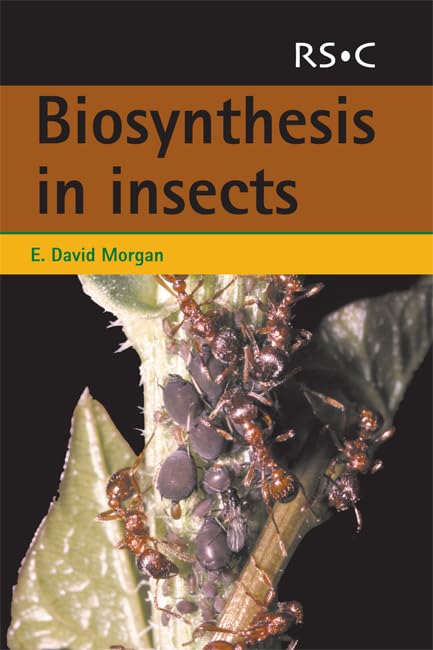
Paperback | 2004 | Author | E David Morgan
The materials in living plants and animals are divided by scientists into two groups: primary and secondary metabolites. Primary metabolites are the substances fundamental to all living matter: simple sugars, amino-acids, nucleotides and fatty acids, etc. Secondary metabolites are substances made by one or a group of species which are not generally vital to the life of the organism. Secondary metabolites may be structural materials, such as bone, chitin or hair, antibacterial or antifungal compounds, they may give protection from predators or foragers, they may be signalling substances (hormones or pheromones) or they may have, as yet, no known function in that organism.
Biosynthesis in Insects The range of secondary metabolites is enormous and presents a never-ending source of research and exploration. What is equally surprising is that this great array of substances is made from relatively few basic building blocks. Figure 1.1 attempts to summarize, very briefly, the way in which all these types of compounds found in nature are made. Notice that the carbon atoms of all substances, from plant or animal, are ultimately derived from carbon dioxide via photosynthesis. The figure shows that many groups of compounds are formed via relatively few biosynthetic paths. Biosynthesis is the building up of chemical compounds through the physiological processes that take place in living animals, plants and micro-organisms.
The chemical study of insects has been growing for four decades, and with it an interest in how insects make their pheromones, hormones, defensive secretions, venoms, pigments and surface coverings. By investigating the biosynthesis of insects, one can gain a greater insight into the structure and function of insect compounds, into ways of disrupting biosynthetic reactions in pest species and how these pathways evolved.
Reviews
There are no reviews yet.