
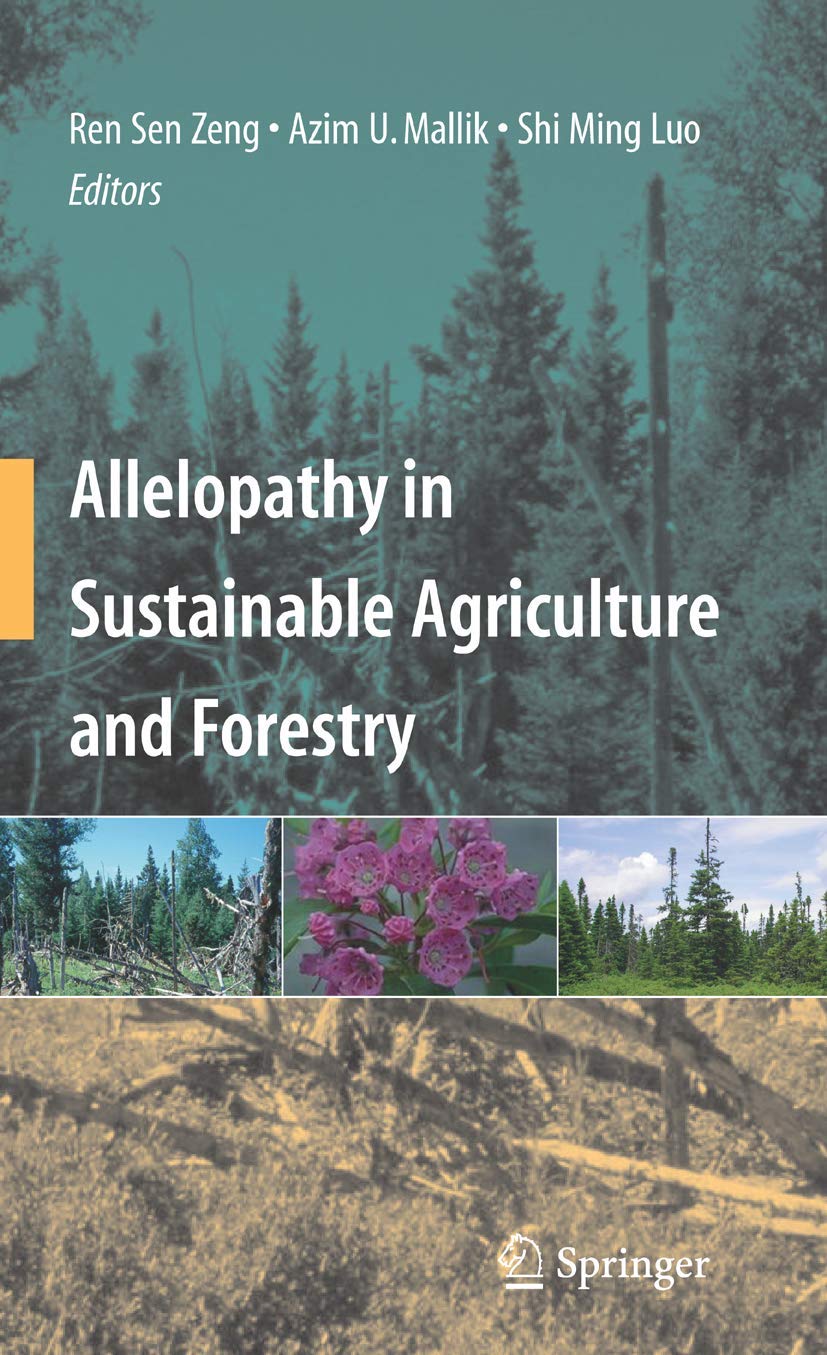
Hardcover – Import, 3 April 2008
by Azim U. Mallik (Editor), Ren Sen Zeng (Editor), Shiming Luo (Editor)
Allelopathy in Sustainable Agriculture and Forestry Simply put, allelopathy refers to an ecological phenomenon of plant-plant interference through release of organic chemicals (allelochemicals) in the environment. These chemicals can be directly and continuously released by the donor plants in their immediate environment as water leachates volatiles in the air or root exudates in soil – or they can be the microbial degradation products of plant residues. Allelochemicals may interfere with survival and growth of neighboring or succeeding plants, and may also discourage insects and pathogens. Black walnut, eucalyptus, sunflower, sorghum, sesame and alfalfa are common examples of plants with allelopathic properties. Likewise, staple crops such as rice, wheat, barley and sorghum also exhibit allelopathic characteristics.
Allelopathy in Sustainable Agriculture and Forestry Knowledge of this form of plant interference on other plants and on disease causing organisms has been used in agriculture since prehistoric time. By manipulating cropping pattern and sequence through mixed cropping or crop rotation, farmers have been able to maintain sustained productivity. However, use of numerous agrochemicals – including a wide range of herbicides, pesticides, fertilizers and genetically modified high yielding crops – has become the characteristic feature of modern industrial agriculture. Not only is the sustainability of crop yield called into question in this form of agriculture, but the extensive long-term and often irreversible environmental degradation including ground water contamination and food safety associated with industrial agriculture are now serious concerns worldwide.


Reviews
There are no reviews yet.